The Room Has a Say: How British Weavers Work With Damp, Dry Air and the Weather
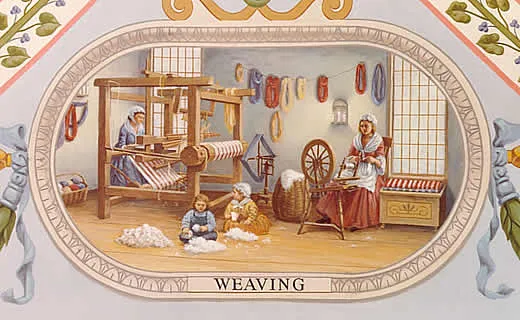
Photo: USCapitol, Public domain, via Wikimedia Commons
In a converted shed on the edge of the Pennines, the first job of the day is not threading up or winding bobbins. It is looking at a small digital hygrometer that sits beside the kettle. If the reading has climbed overnight, the warp will be slacker than it was yesterday. If it has dropped, the wool will feel crisp and the ends will be more likely to snap. The weather is not background noise in a British weaving studio. It is a material condition, and the cloth that comes off the loom carries a record of it.
Wool remembers water
Wool is hygroscopic. It can absorb a significant proportion of its own weight in moisture from the air without feeling damp to the touch. That is useful in a garment. In a warp, it is a variable. A damp wool warp lengthens, softens and stretches; tension that felt right on a dry morning can go slack by mid-afternoon. A very dry room—typically a heated flat in February—makes wool brittle and full of static, and static makes fine singles misbehave at the heddles.
Linen and cotton respond differently again. Linen is stronger damp but can swell; cotton takes up moisture more slowly. A mixed warp is a small climate model. As one weaver in the Welsh borders put it: 'The yarn tells you what the room is doing before the room tells you.'
Three rooms, three climates
British weaving happens in wildly different buildings, and each has its own weather.
The converted shed or barn is often unheated and follows the outdoor humidity closely. It is honest but harsh: condensation on loom metal, rust on reeds, and a smell of damp wool that never quite leaves. Makers here learn to cover the loom at night and to keep a small background heat running through the coldest months, not to make the room warm but to keep it from swinging.
The heated studio flat is the opposite problem. Central heating dries the air, sometimes to 30–40% relative humidity. Wool on the shelf feels papery. Warps tighten overnight as the heating comes on. Static lifts loose fibre and makes the floor a hazard. One weaver in Edinburgh describes moving her yarn store to the coolest corner of the flat, away from the radiator, and letting skeins acclimatise for a full day before winding.
The seaside workshop has its own rules. Salt air and steady damp can be surprisingly kind to wool—it stays supple—but unkind to looms and to any cellulose fibre left out. Mould is the quiet enemy. Makers in Cornwall and on the Suffolk coast talk about air movement as much as heat: a small fan, a dehumidifier on a timer, and never storing yarn against an outside wall.
Tension is a weather report
Ask a weaver how they set tension and you may get a shrug, then a story. Tension is not a fixed number. It is a relationship between fibre, loom and air. A warp tensioned on a cold, damp morning may need tightening by lunchtime as the room dries. A warp wound in dry conditions and then exposed to a damp spell can tighten at the selvedges and slacken in the middle.
Experienced makers adjust in small increments, feeling the warp and watching the shed. Some weigh their warp beams; others use friction brakes and check the shed geometry every few hours. 'I don't set tension once,' one weaver said. 'I set it three times a day, like a gardener watering.'
What actually helps
The practical measures are unglamorous and mostly cheap.
- Buy a hygrometer. A ten-pound one is enough to show you the swing.
- Let yarn acclimatise. Bring skeins into the studio at least 24 hours before warping.
- Store wool in breathable bags or cotton sacks, not plastic. Cedar blocks help against moths; sealed plastic traps damp.
- Keep the loom away from radiators and outside walls. Cover it at night.
- Use gentle background heat rather than a blast. Stability matters more than warmth.
- In coastal or very damp studios, move air. A small fan and a timed dehumidifier do more than a hot radiator.
- Warp in stable conditions where you can. If the room is drying out fast, wait.
None of this is new. Weavers have read the air for as long as there have been looms in damp countries. What is new is how many makers are talking about it again—partly because studios are smaller, partly because energy costs have made us all more aware of the climate we create indoors.
Reading the room
The lesson is not that British weather is bad for weaving. It is that weather is part of the craft. A warp that behaved in March can misbehave in July, and that is not a failure. It is information. The cloth that comes off the loom is not just fibre and tension and time. It is also the room it was made in: the damp, the dry, the draught under the door. Learning to read that is as much a part of weaving as reading a draft.