Hem, Fringe, Press: The Finishing Room Where Handwoven Cloth Finds Its Character
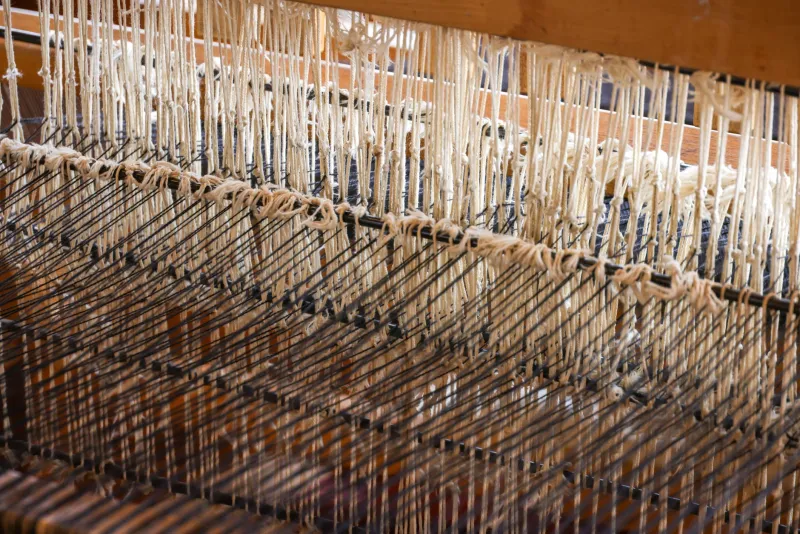
Cloth comes off the loom looking like a rumour of itself. The structure is there, the pattern is there, and you can already see the colour doing its thing. But it is not yet cloth in the way a wearer understands cloth. The edges are raw, the surface is tight with loom tension, and the ends hang loose like a sentence without punctuation. That is where finishing starts — and in a growing number of UK studios, it is where the design actually begins.
The bit everyone skips
In weaving, finishing is often taught last. You learn to warp, to treadle, to throw a shuttle, to read a draft. Then, if there is time left in the course, you learn to hem. It is easy to see why finishing gets pushed to the end of the day: it is slow, repetitive, and hard to photograph. A beautiful weft arrangement will stop a scroll. A hand-sewn hem asks you to look much closer.
But ask a weaver why a scarf costs what it does and the answer often lands here. Not in the yarn alone, or the hours at the loom, but in the final stage: the fringe that is twisted by hand, the hem that is stitched so it disappears, the cloth that is washed, fulled, pressed and left to settle. The last ten centimetres are not a clean-up operation. They are where the maker decides what the cloth is for.
A hem is a hinge
A hem changes how a piece hangs. That sounds obvious until you hold two scarves side by side: one with a deep hand-stitched hem, one with a narrow machine finish. The cloth may be identical, but the hem gives it a different centre of gravity. A weightier hem pulls the drape downwards and makes the scarf feel more formal. A light, narrow hem lets the cloth move. Neither is better. They are different design decisions.
In a small studio in Bristol, a weaver keeps a separate finishing table away from the loom. It is covered in needles, linen thread, a steamer, a heavy old iron and a row of labels. Nothing is woven there. The table is for listening to cloth. A hem that looks neat on the table can feel stiff when it is worn, so she hangs the piece overnight and checks it again in the morning. If the hem is wrong, the scarf tells you.
Fringe as rhythm
Fringe is often treated as decoration, but it is closer to punctuation. A long twisted fringe adds movement and a bit of weight. A short, dense fringe keeps the eye at the edge. A knotted fringe can feel rustic; a rolled hem can feel clean and modern. On a narrow loom, the fringe also affects how the cloth behaves: too much bulk at the end and the piece will not sit flat.
Some UK weavers now leave the fringe until the cloth has been wet-finished, because washing and fulling can change the length and the twist. Others twist the fringe first and then finish the cloth, accepting that the fringe will tighten. Both approaches work. What matters is that the maker is choosing, not just doing what was done last time.
Wet finishing and the honest press
For wool, fulling is the quiet transformation. Gentle washing and agitation can close the gaps between threads, soften the handle and give the cloth a faintly felted surface. A Yorkshire tweed that feels wiry off the loom can become almost buttery after a careful fulling. A linen piece might be washed to loosen the sett and give it that familiar slubby ease. None of this is accidental. It is a controlled process, even when it happens in a bucket.
Pressing is the other misunderstood stage. A hard press can flatten a cloth and make it look commercial in the wrong way. A soft press, or a steam and a rest, lets the yarn recover. Weavers talk about cloth needing time to settle, and they are not being precious. The fibres need to relax after loom tension. Sometimes the best finishing decision is to leave the piece alone for a day.
Where finishing lives
Finishing rooms still exist in the UK, though they are smaller and fewer than they once were. In the Scottish Borders and West Yorkshire, mills have long histories of washing, milling and pressing cloth for others. Some handweavers send work out to these specialists; others keep the whole process in-house because they want control over the final handle. In London, a growing number of small-batch designers work with hand-finishers who can sew a hem, twist a fringe or repair a selvedge without making the cloth look repaired.
Courses are catching up too. Several UK weaving programmes now include finishing as a separate module, not an afterthought. Students are asked to finish the same cloth in two different ways and compare the results. It is a simple exercise, but it makes the point: the loom gives you cloth. Finishing gives you a product, or a piece, or a keepsake — depending on what you choose.
Ten centimetres of decision-making
The last ten centimetres are where a weaving project either becomes cloth or stays an experiment. That is not a call to spend hours on every sample. It is a reminder that finishing is part of the design, not a chore that happens after it. A hem, a fringe, a wash and a press can change the weight, the drape, the surface and the story of a piece. They are small decisions with long consequences.
So next time you pick up a handwoven scarf, look at the edge first. Run your thumb along the hem. Turn the fringe over. The loom did the loud part, but the finishing room did the quiet part — and that is often where the character lives.