Aged on the Loom: The UK Weavers Who Make New Cloth Look Like It Has a Past

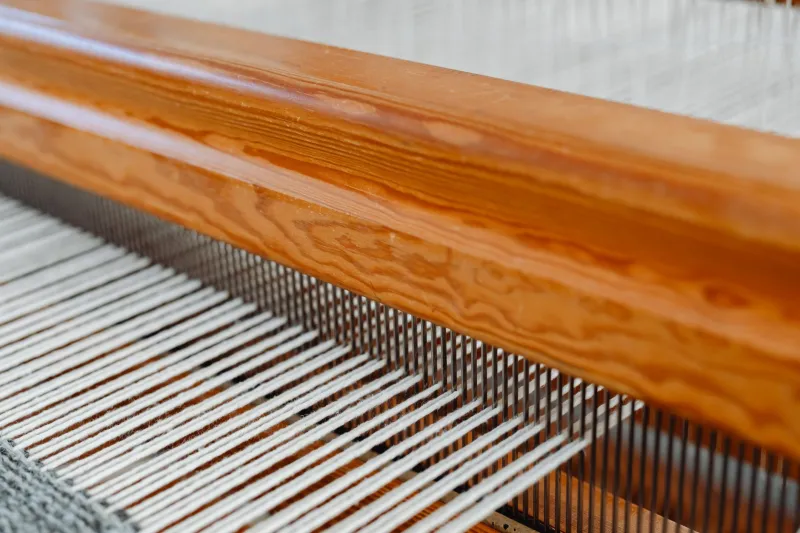
Photo: close-up handwoven wool fabric on loom in weaving workshop, via www.isuzureplacementparts.com
A length of wool can look completely right on a loom and then go wrong under a lens. The colour turns flat, the weave reads too regular, the selvedge behaves like it was made last week — which, of course, it was. For the UK weavers who supply costume houses and period productions, that gap between the workshop and the screen is the whole job. Their cloth has to look old without pretending to be an antique. It has to survive a modern shoot while carrying the mannerisms of another century. And it has to do it on a budget and a deadline that rarely allow for a second go at the warp.
The Brief Is Not ‘Historically Accurate’
Costume designers tend not to arrive with a demand for documentary perfection. They arrive with a character, a scene and a camera. A coat worn by a landowner in a rain-soaked exterior reads differently from the same coat in a candlelit interior. A servant’s apron needs to look washed, not styled. A wedding waistcoat can be rich, but it cannot look as if it came straight from a heritage display case.
That is why the brief often sounds more like fiction than fact: cloth that looks like it has been worn on a Tuesday, a fabric that reads as ‘third-best’, a wool that suggests money but not new money. The weaver’s task is to translate those phrases into yarn count, sett, colour and finish. Historical accuracy is the starting point. Screen legibility is the real target.
The Archive Is a Starting Point, Not a Script
Many of the weavers doing this work keep their own libraries of drafts, old sample books and photographs of museum textiles. Some draw on mill archives in Yorkshire and Scotland; others work from records of domestic weaving or from fragments held in local collections. But copying a period draft exactly can be a trap. A cloth that was perfectly ordinary in the eighteenth century may look oddly pristine on a twenty-first-century screen, especially once a camera has sharpened every line.
So the draft gets adjusted. A slightly looser sett can create the soft, broken surface that reads as age. A yarn with a little more irregularity can do the work that a hundred years of wear might have done. The aim is not fakery for its own sake but a kind of visual shorthand: the eye should believe the cloth before the brain starts asking questions about the weave.
Dyeing for Daylight and for the Grade
Colour is where period work gets particularly interesting. A dye that looks convincing in the workshop can turn strangely modern under a film light or in the grade. Deep indigo may go too blue; a warm brown may lose its depth; a red that feels suitably old in the shade can flare like a warning sign in sunlight.
Weavers often dye small samples and test them under different conditions — daylight, tungsten, the flat glare of an LED panel. Some send samples to the costume house to be filmed. The result is a set of colours that are historically plausible but cinematically reliable. It is not unusual for a cloth to be deliberately muted, or deliberately uneven, because the camera rewards texture and punishes flatness.
Distressing Without Destroying
There is a practical limit to how much ‘age’ a handwoven cloth can take before it stops behaving like cloth. Costume houses may do their own breaking down — washing, shrinking, abrading, staining — but the weaver can build in some of that character from the start. A lightly fulled finish, a hairy yarn, a slightly uneven beat: these are honest ways to make new fabric feel less new.
What weavers tend to resist is anything that undermines the structure. A distressed cloth that falls apart on the third day of shooting is not a success, however good it looked in the fitting. The best period cloth has a kind of controlled softness: it looks worn, but it still holds a seam, still drapes, still survives being pinned and re-pinned by a busy costume department.
The Continuity Problem
Film and television are not like a single commission for a client who wants one length of cloth. A production may need multiple versions of the same fabric: a ‘hero’ garment, a duplicate for a stunt or a wet scene, and perhaps a third for reshoots. The cloth has to match closely enough that the audience never notices, but not so mechanically that it looks printed.
That is one reason handweaving appeals to costume designers. A skilled weaver can repeat a cloth with small, human variations that feel natural rather than industrial. It is also one reason the work can be stressful. A mistake in a metre of cloth is not just a mistake; it is a continuity problem waiting to happen.
Budgets, Deadlines and the Real Cost of ‘Old’
Period drama is not a bottomless purse. Weavers describe a familiar squeeze: the production wants something that feels researched and bespoke, but the schedule assumes something off the shelf. The compromise is often a small run — enough for the principal cast, with cheaper cloth for background or less visible layers. Some weavers work with costume houses to prioritise the pieces that will be seen close up.
The deadlines can be brutal. A weave that would normally take weeks may need to be on a train to London by Friday. That is where experience tells. A weaver who has spent years making cloth for interiors or fashion learns to read a brief quickly, to choose a sett that will behave, and to leave room for the unexpected.
What Film Teaches a Weaver About Cloth
Working for the camera sharpens a maker’s eye. It teaches you that cloth is never just cloth: it is a signal of class, work, weather and time. It teaches you to look at a fabric from three metres away as well as in the hand. And it teaches you that ‘old’ is not a single quality but a collection of small decisions — the irregular yarn, the softened colour, the selvedge that looks as if it has been handled.
For all the pressure, many UK weavers speak warmly of the work. A period production gives cloth a narrative role that everyday commissions rarely do. The fabric is not there to fill a room or finish a garment; it is there to help an actor become someone else. That is a strange and satisfying brief for anyone who works at a loom. New cloth, old story: it is a trick of time, and the best weavers make it look effortless.