Open Warps: Why British Weavers Are Publishing Their Drafts
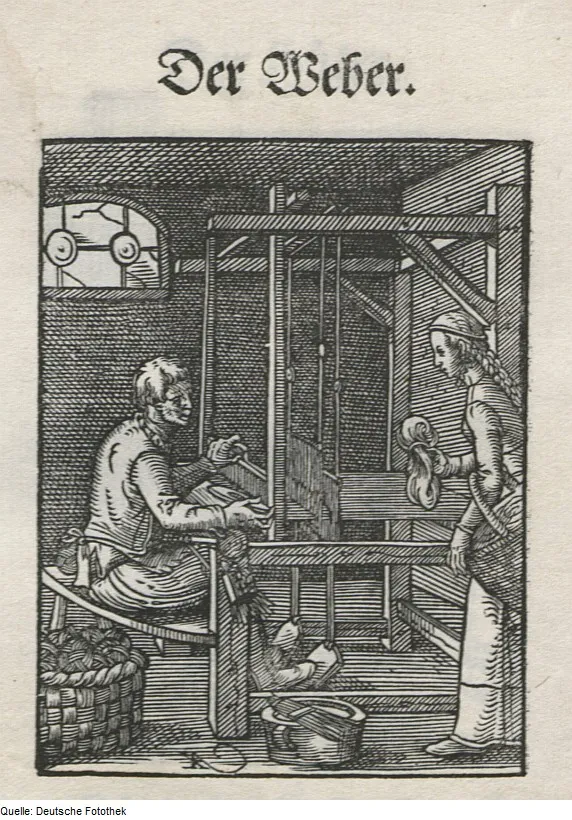
Photo: Unknown, Public domain, via Wikimedia Commons
There is a particular sound a weaving studio makes when someone shares a draft. Paper rustles. A chair scrapes closer. Then comes the long, appraising silence of a weaver reading somebody else's threading — lips moving slightly, finger tracing a liftplan, doing the arithmetic in their head before they say anything at all.
That moment used to happen across a table, usually with a teapot nearby. Increasingly, it happens in a shared folder.
First, What a Draft Actually Is
For anyone who has drifted in from the fashion side of the site: a draft is the recipe for a woven cloth. It records the order the threads are drawn through the heddles, the way the shafts are tied up, the sequence the treadles are pressed, and the resulting drawdown — the little graph-paper picture of the cloth before the cloth exists.
It is notation, not artefact. It is also, for a great many weavers, the most personal thing they own. A draft is where the thinking lives. The yarn is replaceable; the draft is a decision, made once and then repeated for years.
From the Guild Hall to the Shared Drive
UK weaving has never been as secretive as the folklore suggests. The Association of Guilds of Weavers, Spinners and Dyers has run sample swaps for decades, and local guilds from the Borders to Devon still operate on a simple principle: you bring a warp, everyone weaves a length, and the samples go home with somebody else. That is sharing, and it long predates the internet.
But the archive was physical. A ring binder at the back of a church hall. A suitcase of swatches that lived in somebody's spare room and came out twice a year.
The shift, when it came, came quietly and from below. A PDF emailed to three people after a workshop. A Dropbox set up for a class that kept going long after the class ended. A hashtag, then a carousel on Instagram showing a full threading in eight tidy slides. Somebody's Notion page, of all things, listing forty drafts by sett and fibre.
It would be easy to credit the American side of this — Handweaving.net and its vast public-domain archive, or the long-running Weavolution forums, or the Complex Weavers study groups. Those were the proof of concept. What has changed in the last few years is that British makers are now publishing their own drafts, in their own accents, with their own notes attached.
The Licensing Argument Nobody Has Finished
Here is where it gets knotted.
Walk through any UK guild meeting and you'll find weavers doing all of the following:
- Publishing drafts free, on a blog or a PDF, with a request for credit.
- Selling drafts for somewhere between £3 and £12 a go, as one strand of a mixed income.
- Sharing drafts privately with students and asking them not to pass them on.
- Marking drafts "personal use only" and hoping everyone understands what that means.
- Simply not saying anything, and trusting good manners.
None of these are wrong. But they are not compatible with each other either, and the friction shows. There is a genuine grey area here: UK copyright protects the expression of the draft — the chart, the notes, the PDF, the layout — more comfortably than it protects the idea of a twill progression. The law is thinner than the etiquette. In practice, the etiquette is doing all the work, and the etiquette has not been written down.
What the Secrecy Was For
The mill archives guarded their weave plans for reasons that were not romantic. A damask design in Belfast or a tapestry motif in west Wales represented months of development and a competitive edge. Family setts were protected because the cloth paid the mortgage.
But secrecy also protected something smaller and more human: the fear of being seen to get it wrong. A draft alone on a page looks authoritative. A draft with its mistakes included — the sett that was too tight, the weft that broke every forty picks, the version that was quietly abandoned — is far more useful and far less likely to be published.
The Tartan in the Room
Any conversation about pattern ownership in Britain has to make room for tartan. Setts are tied to clans, regiments, regions and institutions, and the Scottish Register of Tartans exists precisely because the question "whose is this?" has real consequences. Welsh tapestry has its own vocabulary of portcullis and meander motifs that carries similar weight.
Sharing a draft is not the same as owning a tradition. Most weavers know this instinctively. But the language of open access — remix, adapt, build on — can flatten that distinction if nobody is paying attention. Credit costs nothing. Asking first costs very little more.
What Gets Gained
A lot, honestly. A new weaver on a rigid heddle loom in a flat in Leeds can now learn from a threading developed in a shed in Cumbria. Someone who cannot easily travel to a guild meeting can still take part in one. A technique that once lived in three heads now lives in three hundred.
And there is a subtler gain: drafts published with their notes attached teach judgement, not just instruction. They show a maker thinking.
What Gets Lost
The table. The tea. The throwaway remark — "have you tried it in 2/10 cotton?" — that saves somebody a fortnight.
A shared folder is a library, and libraries are wonderful, but they are not conversations. Draft-sharing works best when it stays slightly unfinished, when there is still a person at the other end who will answer a question.
A Modest Etiquette, Then
Nothing official, nothing enforceable. But if you are about to upload a draft this month, it might be worth doing five small things: name where it came from, say plainly what it is for, publish one failure alongside the successes, be honest if you sell drafts, and ask before you teach somebody else's pattern to a paying class.
That is not a licence. It is closer to a courtesy — and this craft has run on courtesy for a very long time.