A Loom of One's Own (For a Fortnight): Britain's Borrow-a-Loom Schemes
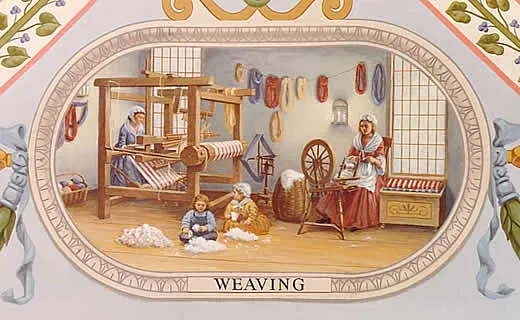
Photo: USCapitol, Public domain, via Wikimedia Commons
There is a particular kind of hopeful optimism that arrives with a first weaving class. You learn to warp, you throw a shuttle, you feel the beat of the beater, and then you go home and start looking at loom prices. That is usually when the optimism meets a wall. A decent table loom costs several hundred pounds. A floor loom can run into the thousands, before you have bought a single cone of yarn. And then there is the small matter of where it might live. For anyone in a flat, a shared house or a rented room, the equation is not just financial. It is spatial.
That is where the lending shelf comes in. Over the past few years, a quiet network of tool libraries, weaving guilds and community studios has begun to treat looms less like private heirlooms and more like shared infrastructure. The idea is not new — guilds have lent equipment to members for decades — but the scale and informality of it is changing. You can now borrow a rigid heddle loom for a fortnight, take a table loom home for a month, or book time on a floor loom that lives in a converted mill. The craft is being opened up, one loan at a time.
The lending shelf
Tool libraries have become familiar in UK cities, usually for drills, ladders and hedge trimmers. Looms are a slightly different proposition. They are not plug-and-play. They need warping, tensioning and a certain amount of know-how, and they can be damaged by well-meaning enthusiasm. That is why most loom-lending schemes come with an induction, a deposit and a conversation about what happens if a part goes missing.
The schemes tend to fall into three types. There are community tool libraries that have added a small weaving section. There are guild collections, often stored in a member's garage or a hired room, where floor looms are lent to members who have been assessed. And there are studio-based schemes, where the loom stays put and you borrow time on it instead. Each has a different flavour, and each asks something slightly different of the borrower.
Three schemes worth a look
In Bristol, a community studio near St Werburghs runs what it calls a loom library. Members pay a modest annual fee, attend a two-hour induction, and can then borrow a table loom or a rigid heddle for two weeks at a time. The looms are basic but well maintained, and each comes with a folder of notes, a reed, a few shuttles and a blunt warning about leaving half-finished warps on the beam. The scheme is deliberately small — six looms, a waiting list, and a volunteer who checks each one before it goes out.
In Leeds, a guild-run loom share works differently. The guild owns three floor looms, stored in a member's workshop, and lends them to members who have completed a warping workshop and can show they have somewhere safe to put one. Borrowing is for a month, with a refundable deposit and a requirement to return the loom cleaned and with any broken parts declared. The guild also pairs borrowers with a mentor, which is perhaps the most valuable part of the arrangement. A loom without someone to call at 9pm on a Sunday is a lonely object.
In Glasgow, a community toolbox scheme lends rigid heddle looms and small weaving kits for shorter periods, aimed at people who want to try the craft before committing to a course. The kits are designed to travel — a loom, a clamp, a few skeins of yarn, a booklet — and they have been used in living rooms, community halls and at least one wedding. The scheme is less about production and more about curiosity. It is a first step, not a studio.
How borrowing actually works
Most schemes follow a similar shape. You join as a member, often for a small annual fee. You attend an induction, which covers basic warping, tension, cleaning and what to do if a heddle breaks. You pay a deposit, which is returned when the loom comes back in reasonable condition. You book a slot, collect the loom, and bring it back on an agreed date. Some schemes include a yarn allowance; most do not. Almost all ask you to remove your warp before returning the loom, or to ask before leaving a project on it.
The details matter. Ask about insurance, transport and spares before you commit. A floor loom will not fit in a hatchback, and a table loom is heavier than it looks. Ask what happens if a part goes missing, and whether the scheme has a supply of reeds, heddles and brake springs. Ask how long you can realistically keep the loom, and what the penalty is for late returns. The answers will tell you whether the scheme is run with care or just enthusiasm.
What to check before you take a loom home
Space is the first check. A table loom needs a sturdy surface and enough room to move the beater. A floor loom needs floor space, headroom and a doorway wide enough to get it through. Noise is the second check. A loom is not loud, but it is rhythmic, and thin walls have a way of amplifying a beater. Third, check the manual. If the scheme cannot provide one, find a copy online before you borrow. Fourth, check the parts. Reeds, heddles, shuttles, aprons, cords and brake springs all wear out. A loom that arrives with a missing heddle is a loom that will sit unused.
Finally, check the return date. Borrowing is not the same as owning, and the deadline is part of the deal. The best schemes build in a buffer — a few days for cleaning and folding — and they are clear about what happens if you need more time. A good loan is not a test of memory. It is a small agreement between people who want the loom to keep working.
The slow-craft question
There is a reasonable worry that shared equipment makes weaving feel like a gym membership: convenient, low-commitment, easy to drift away from. The craft's character is slow, tactile and cumulative. It asks for attention. A loom that arrives for a fortnight and then disappears might encourage dabbling rather than depth.
But the evidence from the lending shelf is more encouraging than that. Borrowers tend to be people who have already done a course, already felt the rhythm, already want to know whether the craft fits their life. The loom is the expensive bit; the time is still theirs. And sharing equipment can create accountability. When a guild mentor checks in, when a studio volunteer asks how the warp is holding up, when a borrower knows the loom is booked by someone else next month, the craft becomes social rather than solitary.
The real risk is not convenience. It is the assumption that access alone is enough. A borrowed loom without support is just a heavy object in a spare room. The schemes that work best pair equipment with induction, mentoring and a community of people who can answer questions. They do not flatten the craft. They widen the door.
A loom, for now
Borrowing a loom is not a shortcut to mastery. It is a way of finding out whether you want to make room for the craft. For some borrowers, a fortnight with a rigid heddle is enough — a scarf, a sample, a sense of what the hands can do. For others, it is the beginning of a longer relationship, perhaps with a second-hand loom of their own, perhaps with a studio membership, perhaps with a guild that meets on a Tuesday night.
The loom library is not a revolution. It is a shelf, a booking system and a group of people who have decided that equipment should be used rather than stored. In a craft that has always depended on passing things on — skills, patterns, warps, looms — that feels like a natural next thread.