Loose Ends and Honest Pages: Why Weavers Are Opening Up Their Swatch Books
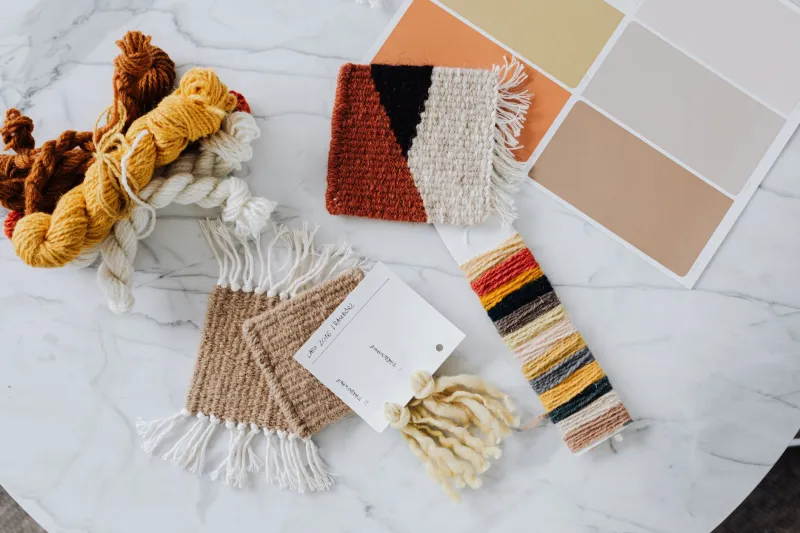
There's a table in a shared studio in Bristol that I keep thinking about. On it: forty cardboard squares, each one mounted with a scrap of cloth no bigger than a beer mat. Some are gorgeous — a soft oatmeal twill with a fleck of blue in the weft. Some are, frankly, a mess. There's a warp that looks like it lost an argument. There's a bit of cloth with a note pinned to it that just says no.
That table is a swatch book, opened out. And increasingly, it's the first thing a UK handweaver shows you rather than the last.
The sample book was never meant to be seen
Traditionally, a weaver's sample book is a working object. It's where you record sett, yarn count, take-up, what happened when you changed the reed, what happened when you didn't. It's a lab notebook with cloth glued into it. Trade buyers might see it; you, the person buying one scarf, almost certainly would not.
What's changed — slowly, over the last several years, and very visibly in 2026 — is that weavers have worked out that the messy pages are the pitch. Not because buyers want to see failure for its own sake, but because a finished scarf on a hanger tells you almost nothing about why it costs what it costs.
A swatch, by contrast, tells you everything.
What you're actually looking at
If a weaver hands you a sample book, here's a rough translation of the marks you'll find in it.
The pencilled numbers are usually sett — ends per inch — and picks per inch in the weft. Change one and you get a different cloth from the same yarn. A weaver showing you two samples of the same yarn at different setts is showing you that cloth is a decision, not a material.
The tabs and staples are a timeline. Samples get mounted as they come off the loom, so left to right is usually earlier to later. Watch for a shift in confidence — bolder colour, finer yarn, more complicated float structures.
The failures are the point. A good sample book has as many rejects as keepers. Ask about them. Every weaver I've spoken with has a story about a warp that went wrong four metres in, and every one of those stories ends with a change to the way they work.
The feel is data. Swatches exist partly because photographs lie about cloth. A swatch lets you check drape, weight, whether the wool prickles, whether the silk has any body to it.
Why the wall came down
Part of this is commercial pragmatism. Handweaving in the UK is a small market with long lead times, and a buyer who understands the process is a buyer who doesn't faint at the quote. Showing the work is a way of pricing honestly without apologising.
"I used to think the sample book was the unglamorous bit," says Ruth, a weaver working out of a converted mill building in Lancashire. "Then I realised clients were asking the same three questions every time — how long, why so much, can it be washed — and all three answers were already in the book."
Part of it is cultural, too. Open studios, craft open days and the general drift of making towards transparency have made the process a thing audiences actively want. The success of the Association of Guilds of Weavers, Spinners and Dyers events, the steady footfall at textile degree shows, the number of people who'll happily watch a floor loom for twenty minutes — all of it suggests an appetite for the how, not just the what.
And part of it is digital. Cloth libraries hosted by individual studios — photographed swatches with yarn specs, sett, weight in gsm, and a note on what the cloth is good for — have become a low-cost way for a one-person workshop to look like a proper archive. You can browse a weaver's range from a train between Leeds and Sheffield and come away knowing exactly what a 300gsm herringbone in Cheviot will feel like against your neck.
Swatches as storytelling, not secrecy
The old logic was that sample books were proprietary. Your structure was your edge; you kept it in the drawer. The newer logic is that the edge isn't the structure — it's the judgement. Anyone can copy a twill. Not everyone can look at a warp and know it needs a different reed.
So the swatch goes on the wall. The studio puts a photograph of the wrong warp in the newsletter. The weaver tells you, unprompted, that the first version of your cloth was too stiff and the second one is the one they'd wear themselves.
It's a small shift in posture, but it changes the transaction. You're no longer buying a mysterious object. You're buying into a series of decisions, at least one of which was a mistake.
What to ask before you commission
If you're commissioning cloth — a length for a coat, a set of napkins, a wedding something — the swatch book gives you a script. Try these:
- "Could I see the same yarn at two different setts?" It's a completely reasonable request and it will tell you whether the weaver is thinking about cloth or just about colour.
- "What's the weight in gsm, and what does that mean for how it hangs?" Numbers, not adjectives.
- "What's the sample that didn't work?" The answer tells you more about the studio than the lookbook does.
- "Will the cloth I get match this swatch, or will it shift?" Handwoven cloth varies. A good weaver will tell you where the variation will land and why.
- "Who spun the yarn and where?" In the UK in 2026 there's a decent chance the answer involves a small mill in Yorkshire, Devon or the Borders — and that's worth knowing.
Where to see one
Sample books are showing up in places they didn't used to. Open studio weekends at places like Cockpit Arts in London, the studios around New Brewery Arts in Cirencester, and the various mill-turned-workshop buildings across Lancashire, Yorkshire and the Scottish Borders are the obvious route. Textile degree shows and the graduate showcases at the major colleges are worth a visit for the sheer range of structures — students are often more willing to show process than anyone.
And if you can't get out, look at how a studio photographs its work. Weavers who show you the back of the cloth, the loom in mid-warp, the pile of rejects — those are the ones keeping an honest book.
A swatch is a small thing: a few inches of cloth, a staple, a pencilled number. But a swatch book is a record of thinking, and thinking is the bit of handwoven cloth you can't fake.